Vestis (VSTS)·Q1 2026 Earnings Summary
Vestis Stock Jumps 7% After Q1 Beat as Transformation Takes Hold
February 10, 2026 · by Fintool AI Agent
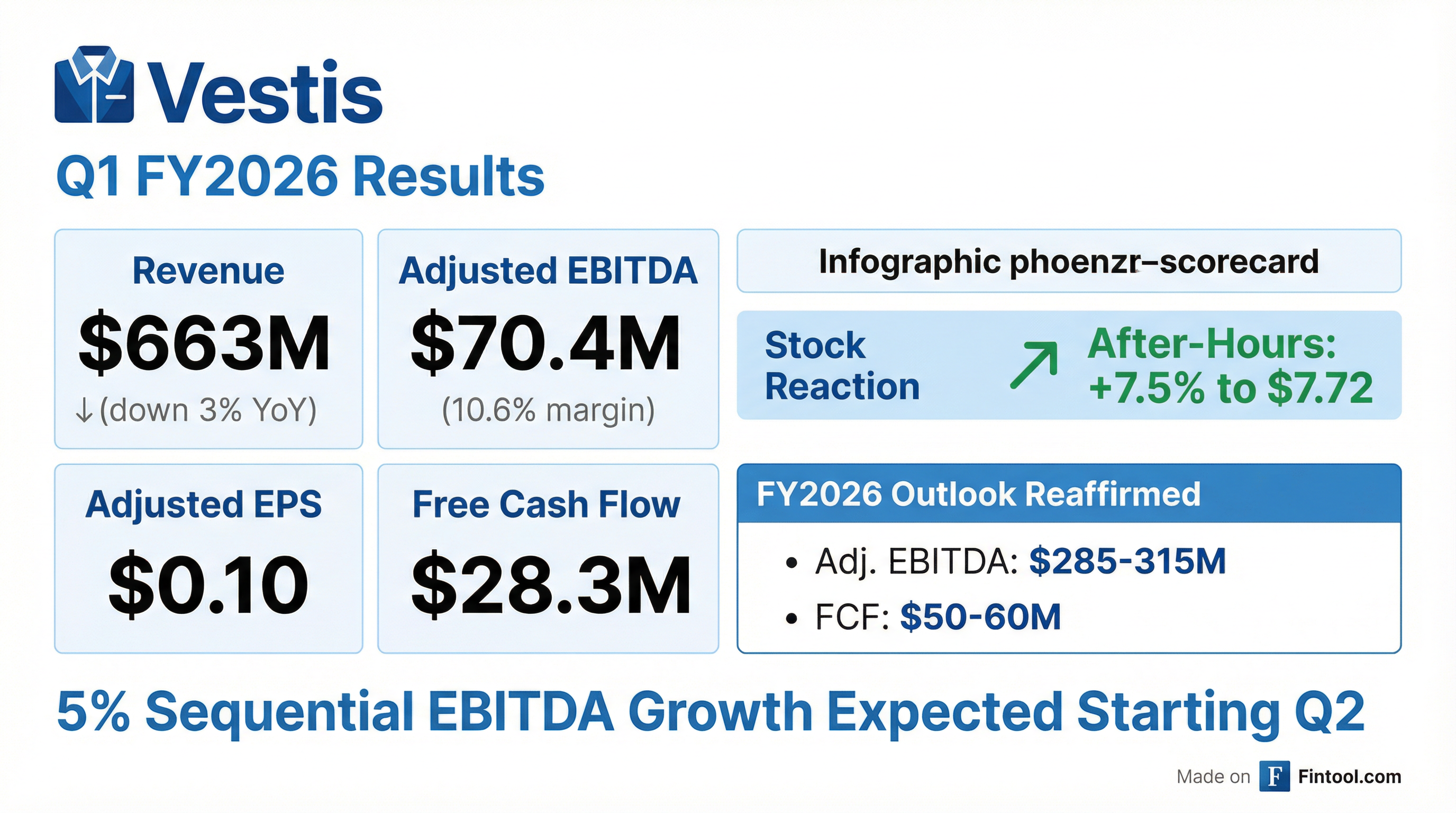
Vestis Corporation (NYSE: VSTS) delivered a solid start to fiscal 2026, with shares jumping 7.5% after-hours to $7.72 following results that showed early traction from the company's business transformation plan. While revenue declined 3% year-over-year, sequential improvements in Adjusted EBITDA and free cash flow signaled the operational turnaround is gaining momentum.
Did Vestis Beat Earnings?
The quarter delivered mixed results against a challenging year-over-year comparison, but showed encouraging sequential trends:
The sequential improvement is the key story here. After a challenging FY2025 that saw Adjusted EBITDA decline from $81.2M in Q1 to $47.6M in Q2, the company has now posted two consecutive quarters of sequential margin expansion.
Key drivers of the quarter:
- Volume stable: 485 million pounds processed, flat year-over-year
- Revenue per pound declined: Down $0.04 to $1.37 on product mix shift and legacy commercial practices
- Cost per pound improved: Down $0.02 to $1.22 on transformation initiatives
- Business retention: 91.2%
 Ask Fintool AI Agent
How Did the Stock React?
The after-hours move to $7.72 (+7.5%) represents a significant sentiment shift for a stock that has been under pressure since spinning off from Aramark in September 2023:
The stock has rallied ~80% from its August 2025 lows around $4.36, as investors began to see signs of stabilization. Today's results and reaffirmed guidance appear to validate the turnaround thesis.
What Did Management Guide?
Vestis reaffirmed its FY2026 outlook, maintaining the guidance originally set in November:
The key forward indicator: management expects quarterly sequential Adjusted EBITDA growth of ~5% starting with Q2'26. If achieved, this would imply:
- Q2 FY26 Adjusted EBITDA: ~$74M
- Q3 FY26 Adjusted EBITDA: ~$78M
- Q4 FY26 Adjusted EBITDA: ~$82M
- Full Year: ~$305M (midpoint of guidance)
What Changed From Last Quarter?
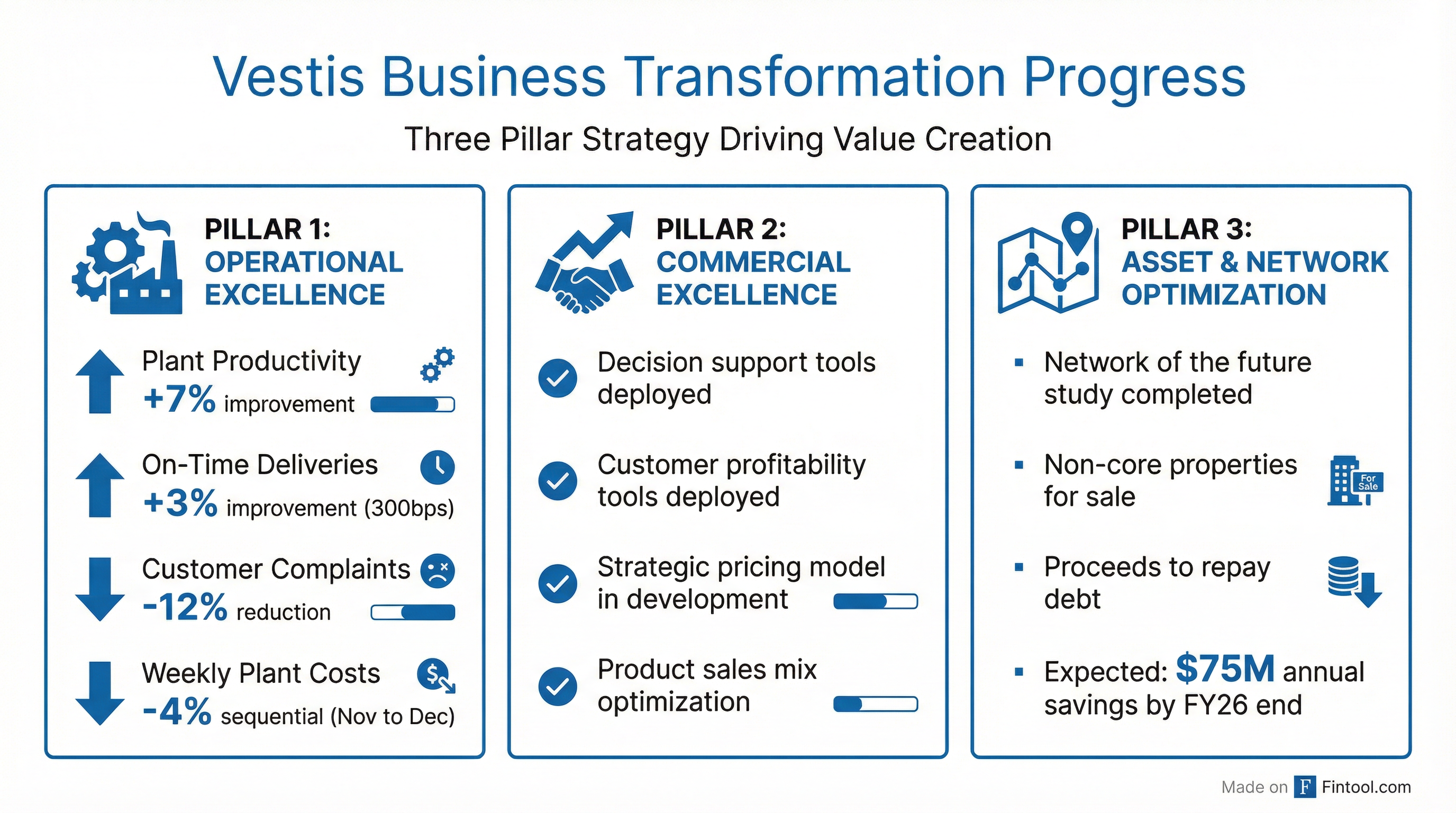
This quarter marked the formal launch of Vestis's three-pillar transformation plan. CEO Jim Barber emphasized the company is making "meaningful progress advancing operational excellence priorities."
Operational Excellence
COO Bill Seward joined the call to field operational questions—a first since the company went public. The most tangible results came from plant operations:
- Plant productivity: +7% improvement vs Q1 FY25 (measured per operating hour)
- On-time deliveries: +300bps improvement vs Q1 FY25
- Customer complaints: -12% reduction YoY
- Weekly lost business: -15% reduction from Q4 FY25 to Q1 FY26
- Weekly plant costs: -3.7% sequential improvement (November to December)
Commercial Excellence
Management is investing in profitability tools to accelerate strategic pricing:
- Customer and product profitability segmentation tools deployed
- Strategic pricing model under development
- Focused on favorable product sales mix
- Targeting better customer penetration
Asset & Network Optimization
The company completed market studies for its "network of the future":
- Actively marketing non-core properties for sale
- Proceeds will be used to repay debt
- Network optimization ongoing
Ask Fintool AI AgentKey Management Commentary
CEO Jim Barber set clear expectations for how investors should evaluate the business going forward:
"We're managing Vestis as a pennies business. The compounding effect of small, disciplined decisions on mix, pricing, delivery, plant, and SG&A is how we build sustainable, profitable growth and shareholder value."
On operating leverage as the key metric:
"Every penny of improvement in cost per pound is worth approximately $5 million of Adjusted EBITDA on our current total volume and mix levels."
On transformation timeline, Barber used a baseball analogy:
"If I'm in baseball, I would say we're in the first inning right now. This is a continual move quarter-over-quarter, and it will be a blend of cost per pound improvement and revenue per pound improvement."
What's Driving the Revenue Decline?
Revenue declined 3% year-over-year despite flat volume, driven by two factors:
-
Product mix shift: Volume shifting from uniforms (higher revenue per pound) to workplace supplies like linen and towels (lower revenue per pound)
-
Legacy commercial practices: Pre-transformation pricing decisions that are no longer in effect
CFO Adam Bowen provided critical context: while total pounds processed were flat year-over-year, the company processed 2% fewer uniform pounds but increased linen volume by 7%. Linen and linen-adjacent products (towels, aprons) are significantly more costly to process than uniforms, creating both revenue and margin headwinds.
The revenue per pound decline of $0.04 (from $1.41 to $1.37) equates to roughly $20 million of revenue headwind—essentially the entire YoY revenue decline. However, management is focused on improving revenue quality over revenue quantity through better pricing discipline and customer profitability.
Balance Sheet and Liquidity
Free cash flow turned positive in a meaningful way:
Working capital improved by $12.7 million, driven by inventory and receivables reductions.
SG&A discipline: Reported SG&A was down ~$1M YoY, but when adjusted for $7.8M in third-party transformation support costs and $5.5M in severance, SG&A was down ~$14M or 12% year-over-year.
Liquidity position:
- Total available liquidity: $317M
- Cash on hand: $42M
- Undrawn revolver capacity: $275M
- No debt maturities until 2028
Leverage:
- Net Debt: $1.29B
- TTM Covenant Adjusted EBITDA: $267M
- Net Leverage Ratio: 4.83x (vs 4.72x in Q4)
The slight leverage increase reflects the lower trailing EBITDA, but management expects the ratio to decline as EBITDA improves sequentially through the year.
Key Risks and Concerns
Several factors warrant monitoring:
-
Revenue per pound pressure: The $0.04/lb decline represents real pricing headwind that needs to stabilize
-
Leverage remains elevated: At 4.83x, the company has limited financial flexibility
-
Transformation execution risk: $75M savings target requires continued operational discipline
-
Customer churn: 91.2% retention leaves ~9% of revenue at risk annually
-
Tariff exposure: Company flagged potential impacts from trade policy changes
Q&A Highlights
Analysts probed several key topics during the call:
On transformation cost savings cadence (Goldman Sachs): CFO Adam Bowen provided specific quarterly phasing for the $40M in-year savings target:
- Q1: ~$5M increment vs Q4 (achieved)
- Q2: ~$9M additional
- Q3: ~$13M additional
- Q4: ~$13M additional (similar to Q3)
On macro demand (Jefferies): Management emphasized they are seeing "no waning in demand" with volumes stable on a pound basis year-over-year and no shift in key vertical concentration. CEO Barber added the macro environment is "secondary" to executing the transformation foundation correctly.
On plant productivity measurement (William Blair): The 7% plant productivity improvement is measured on a per operating hour basis, using technology the company already had but hadn't fully leveraged. CFO Bowen noted December showed a 3.7% sequential improvement in weekly plant costs vs November—a leading indicator that benefits will flow through in future quarters.
On new business mix (Goldman Sachs): The company's new customer acquisition remains roughly 60% from competitors ("programmers") and 40% from non-programmed accounts (first-time outsourcers), with no dramatic shift in that ratio.
On revenue per pound trajectory (Barclays): CEO Barber emphasized that revenue per pound shouldn't be viewed in isolation—it must be considered alongside cost per pound to understand true operating leverage. The plan is to improve revenue per pound throughout the year through pricing and mix actions.
What Should Investors Watch Going Forward?
The next few quarters will be critical to prove the transformation is sustainable:
Q2 FY26 Expectations (per management):
5% sequential Adjusted EBITDA improvement ($74M)- Continued cost per pound improvement
- Progress on non-core asset sales
Key metrics to track:
- Operating leverage (revenue per pound minus cost per pound) — currently $0.15
- Plant productivity trends
- Weekly lost business rates
- Debt paydown from asset sales
Ask Fintool AI AgentThe Bottom Line
Vestis delivered a quarter that, while still showing year-over-year declines, demonstrates the transformation plan is gaining traction. The sequential improvement in EBITDA margin (from 9.1% to 10.6%) and return to positive free cash flow give credibility to management's reaffirmed guidance.
The 7.5% after-hours move suggests investors are warming to the turnaround story. At ~$8 per share, Vestis trades at roughly 3.8x FY26E EBITDA (midpoint), a significant discount to uniform services peers. The question is whether management can continue executing on the ~5% sequential EBITDA improvement they've outlined.
For now, the transformation appears to be working. But with elevated leverage and continued revenue pressure, there's limited margin for error.
Data sourced from Vestis Corporation Q1 FY2026 8-K filing dated February 10, 2026. Stock prices from market data. Estimates from S&P Global.